Malaysia has become one of the fastest-growing PUBG Mobile markets in Southeast Asia, with thousands of players competing daily and a vibrant esports ecosystem. The mobile battle royale scene in Malaysia combines strong infrastructure, passionate community support, and competitive tournaments that draw international attention. Mobile connectivity improvements across the region have reduced ping times to under 30ms for most players, enabling smoother rotation and survival strategies. This guide covers everything from basic gameplay to advanced PUBG Mobile tips, tournament calendars, and the country’s role as a regional esports hub.
Overview of PUBG Mobile in Malaysia
Malaysia ranks among the top five countries in Southeast Asia for PUBG Mobile active users, with an estimated 2.8 million monthly players as of early 2026. The game’s accessibility on mid-range smartphones and widespread 4G coverage have fueled its adoption. Telco providers such as Maxis, Celcom, and Digi offer gaming-specific data packages that prioritise PUBG Mobile traffic, keeping latency below 40ms even during peak hours.
The competitive scene is anchored by the PUBG Mobile Super League Southeast Asia (PMSL SEA), which features Malaysian squads competing against teams from Indonesia, Thailand, and Singapore. Prize pools for regional qualifiers often exceed RM 100,000, attracting both amateur and semi-professional rosters. Beyond esports, the social aspect drives engagement: in-game clans, community Discord servers, and Facebook groups unite players who share PUBG Mobile weapons builds, rotation tactics, and PUBG Mobile sensitivity settings.
Content creation has flourished alongside competitive play. Streamers on Facebook Gaming and YouTube broadcast scrims, rank pushes, and tutorial sessions that attract tens of thousands of viewers. This ecosystem supports a sustainable pipeline of talent, from casual fans to professional players signed by organisations with international backing.
How PUBG Mobile Became Popular in Malaysia
PUBG Mobile launched globally in March 2018, but Malaysia’s player base surged in late 2019 when local telecom operators began bundling in-game currency with prepaid plans. Affordable smartphones equipped with Snapdragon 600-series chipsets made the game accessible to students and young professionals. Offline gatherings at cybercafés and university campuses further normalised mobile gaming as a social activity rather than a solitary hobby.
Collaborations with educational institutions, notably UiTM (Universiti Teknologi MARA), legitimised esports as a career path. UiTM introduced a diploma track in esports management in 2025, and PUBG Mobile clinics became part of extracurricular programming. This academic endorsement shifted parental perceptions, allowing younger players to pursue competitive gaming with family support.
Marketing campaigns tied to Ramadan and festive seasons offered themed skins and limited-time modes, resonating with local culture. Partnerships with popular Malaysian influencers amplified reach beyond traditional gaming circles. By mid-2024, Malaysia hosted its first PUBG Mobile-exclusive convention, drawing over 5,000 attendees and cementing the title’s cultural footprint.
Basic Gameplay and Match Formats in Malaysia
PUBG Mobile follows a 100-player battle royale format: players parachute onto an island, scavenge PUBG Mobile weapons and equipment, and eliminate opponents while staying inside a shrinking safe zone. Matches last 25 to 35 minutes. Victory requires balancing aggression with smart rotation—moving towards the centre of each new circle while avoiding open terrain that exposes you to sniper fire.
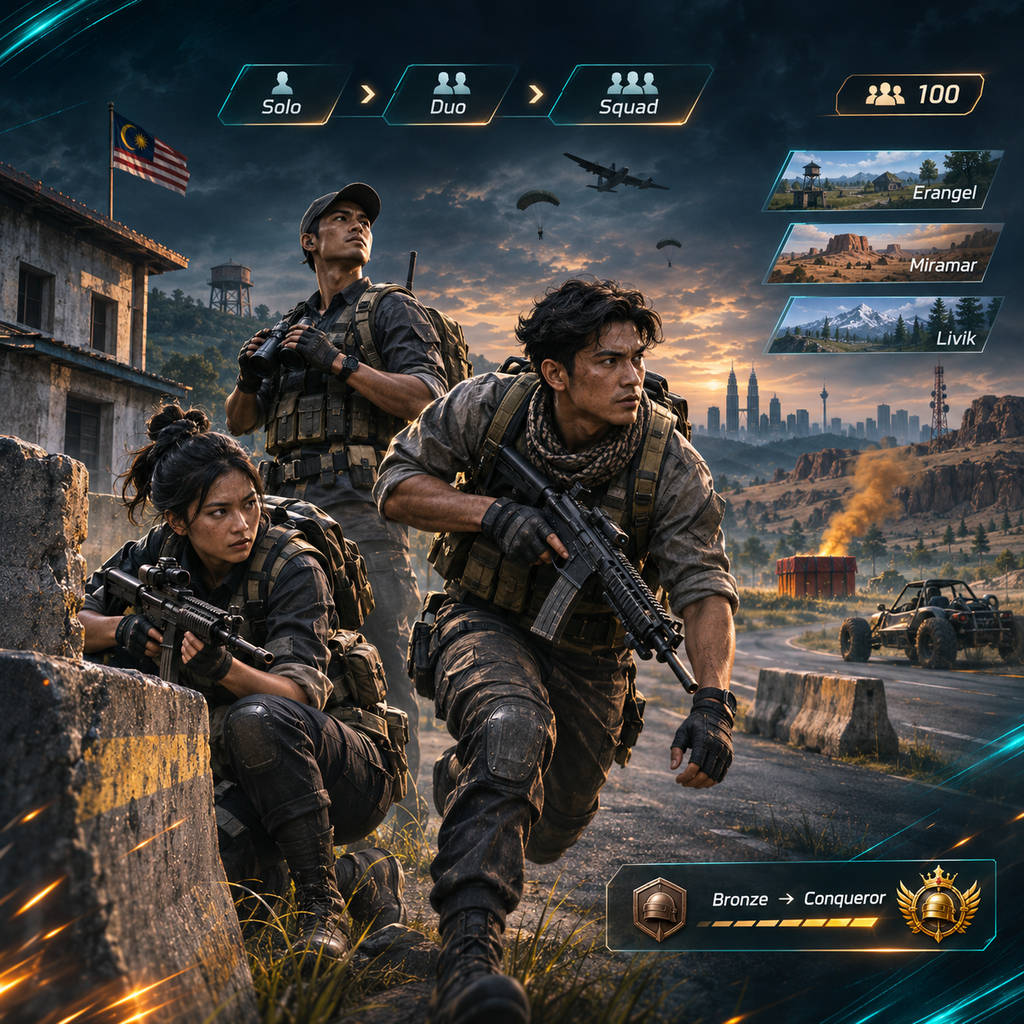
Two primary match formats dominate Malaysian servers. Classic mode offers solo, duo, and four-player squad queues on maps such as Erangel, Miramar, and Livik. Ranked mode uses a tier system from Bronze to Conqueror, with seasonal resets every two months.
Players earn points for kills, assists, survival time, and final placement. Reaching Crown or Ace tier unlocks exclusive frame rewards and increases visibility for recruitment by competitive teams.
Arena mode provides fast-paced 4v4 deathmatches on compact maps, ideal for practicing close-quarters combat and testing PUBG Mobile sensitivity settings without the time commitment of a full battle royale round.
Training grounds let players trial every weapon and attachment combination, refine recoil control, and benchmark frame rates before entering ranked lobbies.
Popular Maps and Game Modes
Erangel remains the most-played map in Malaysia, favoured for its balanced mix of urban compounds, open fields, and forested cover. Hot-drop locations such as Pochinki and School attract aggressive players seeking early kills, while conservative squads prefer edge drops at Zharki or Primorsk to loot safely before mid-game rotations.
Livik, a 2×2 km map designed for 15-minute matches, is popular among players with limited session time. Its compact size forces frequent firefights and rewards players who master close-range PUBG Mobile weapons like the UMP45 and shotguns. Sanhok and Miramar see regular rotation in tournament map pools, requiring teams to adapt vehicle-based rotation strategies and leverage terrain elevation.
Seasonal event modes introduce variety: Payload mode adds helicopters and rocket launchers, Metro Royale blends battle royale with persistent loot that carries between sessions, and Infection mode pits survivors against zombie hordes. These limited-time modes keep engagement high between ranked seasons and serve as testing grounds for experimental mechanics.
Malaysian PUBG Mobile Teams and Players
Several Malaysian squads have earned regional recognition. Team Secret Malaysia, backed by a global esports organisation, placed third in the PMSL SEA Spring 2026 finals, earning RM 45,000 and a slot at the international championship. Geek Fam, originally a Dota 2 powerhouse, expanded into PUBG Mobile in 2024 and secured sponsorships from peripheral brands and energy drink companies.
Individual standout players include Raziq “RazQ” Halim, known for aggressive entry fragging and clutch plays with the M416, and Nurul “Nunu” Aisyah, one of the few female players competing at the highest tier. Nunu’s consistent top-10 finishes in mixed-gender tournaments have inspired community development initiatives aimed at encouraging more women to join competitive rosters.
Semi-professional teams often form through university leagues. UiTM Esports Club fields multiple PUBG Mobile squads that compete in collegiate circuits, with top performers receiving scholarships and stipends. This grassroots infrastructure ensures a steady flow of talent into the professional ecosystem.
Major PUBG Mobile Tournaments in Malaysia
The PUBG Mobile Pro League Malaysia (PMPL MY) serves as the primary national competition, running three splits per year with a total prize pool exceeding RM 300,000. The top four teams from each split advance to the PMSL SEA regional finals, where they compete for international championship berths and larger prize purses. Matches are broadcast live on YouTube and Facebook Gaming, with Malay and English commentary tracks.
University-level tournaments such as the Malaysia Esports League draw hundreds of student teams. Entry is free, and organisers provide bootcamp sessions covering PUBG Mobile tips on rotation timing, compound clearing, and late-game positioning. Winners receive gaming hardware, in-game currency, and invitations to exhibition matches against professional rosters.
Community-run tournaments hosted on Discord and WhatsApp groups offer smaller cash prizes and serve as talent scouting grounds. Organisers enforce fair-play rules using spectator tools and replay analysis to detect cheating, maintaining competitive integrity even in grassroots events.
Mobile Esports and Competitive Scene
Malaysia’s mobile esports infrastructure has matured rapidly. Purpose-built esports arenas in Kuala Lumpur and Johor Bahru feature stage setups, broadcast facilities, and high-speed internet optimised for tournament play. Event organisers coordinate with telecom providers to reserve dedicated bandwidth during finals, ensuring sub-20ms ping for all participants.
Professional players typically train six to eight hours daily, split between scrims against other top teams and solo rank pushing to maintain Conqueror status. Coaches analyse match replays to identify rotation errors, positioning mistakes, and opportunities to secure high-ground advantage. Bootcamps before major tournaments involve mock matches simulating tournament rulesets, including specific map pools and point distribution formulas.
Sponsorship deals have evolved from peripheral gear to lifestyle brands and financial services. Players negotiate contracts that include salary, performance bonuses, content creation quotas, and revenue shares from merchandise sales. This professionalisation mirrors trends in PC and console esports, signalling that mobile titles command serious commercial investment.
Streaming, Content Creators, and Community in Malaysia
Facebook Gaming dominates the Malaysian streaming landscape, with top PUBG Mobile creators averaging 10,000 to 30,000 concurrent viewers during evening streams. Creators mix ranked gameplay with tutorial segments covering PUBG Mobile sensitivity settings, ideal gyroscope configurations for different device models, and loadout recommendations for specific maps.
YouTube channels focus on edited highlight reels, weapon comparison videos, and patch analysis. Channels such as “MY PUBG Tactics” and “ProMobile MY” publish weekly guides on using the M416 with compensator versus flash hider, the best scopes for the UMP45 in urban combat, and how to adjust ADS sensitivity for recoil control. These resources are especially valuable for new players looking to accelerate their learning curve.
Community-driven initiatives include free coaching sessions organised through Telegram groups, where experienced players review VODs submitted by lower-ranked users and provide personalised PUBG Mobile tips. Discord servers host daily scrims, tier-based tournaments, and voice channels for squad formation. This collaborative culture strengthens player retention and fosters a welcoming environment for newcomers.
Tips for New PUBG Mobile Players
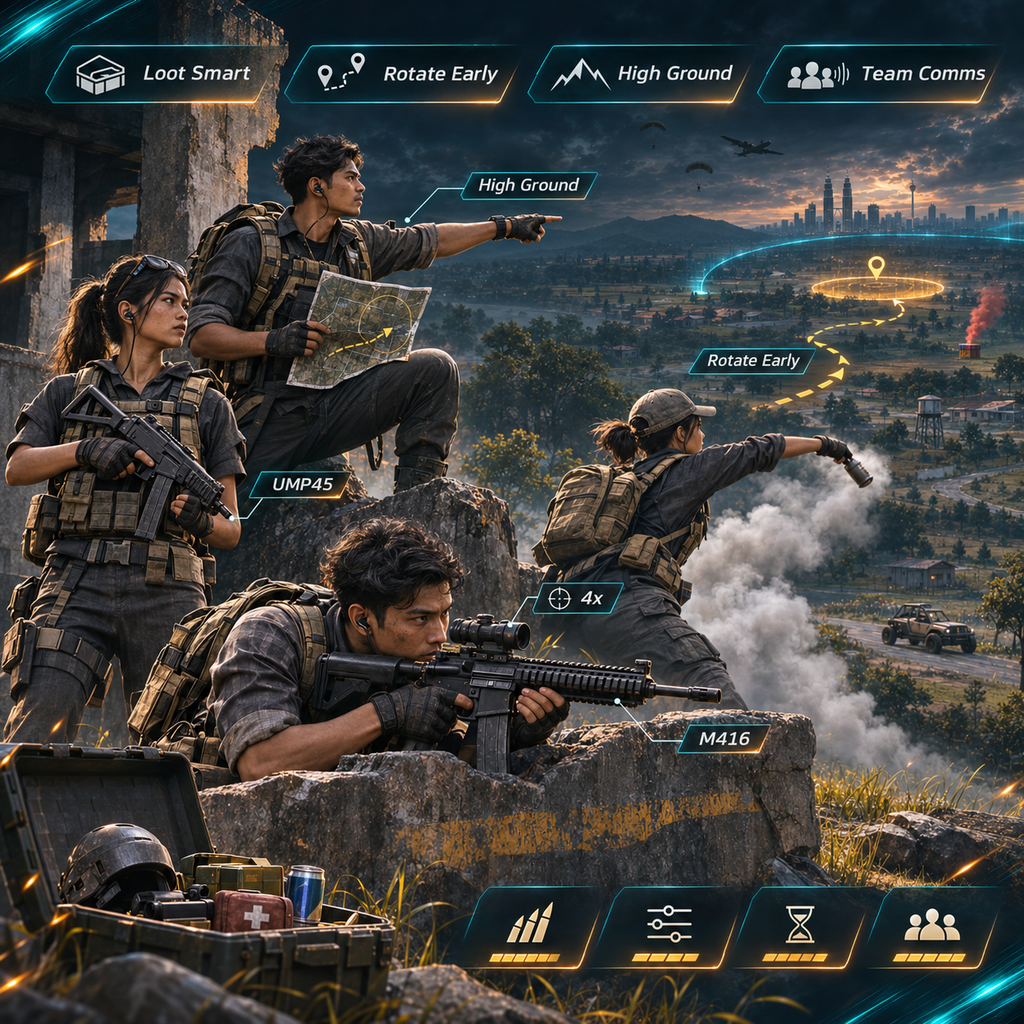
Start by landing in moderate-traffic zones such as Mylta or Gatka on Erangel to gather loot without immediate combat pressure. Prioritise securing a primary assault rifle—M416 or AKM—and a close-range option like the UMP45. Attach a red dot or holographic sight for early fights, upgrading to a 3x or 4x scope once available.
Master PUBG Mobile sensitivity settings through the training mode. Begin with default values, then lower ADS sensitivity by 10 percent increments until you can control vertical recoil on full-auto bursts.
Gyroscope settings can enhance fine aim adjustments; enable gyroscope for scoping only and set sensitivity between 150 and 200 percent, testing which value feels natural for your device orientation and grip.
Rotation timing determines survival in mid and late game. Move towards the next safe zone as soon as it appears, avoiding the temptation to loot every compound.
Use vehicles for long rotations but dismount 200 metres before your target position to avoid drawing attention. In the final circles, prioritise cover and high ground over aggressive pushes; patience wins more matches than kill-chasing.
Communicate with squadmates using quick-chat commands or voice chat. Call out enemy positions with compass bearings and distance estimates, coordinate smoke grenades for revives, and share spare attachments and healing items.
Effective teamwork multiplies individual skill and is the foundation of success in ranked and competitive play.
The Future of PUBG Mobile in Malaysia
The PUBG Mobile 8th Anniversary in 2026 brought significant updates, including enhanced graphics for devices with Snapdragon 8 Gen 2 chipsets and expanded partnership programs with Malaysian telcos. Signals point towards greater investment in East Malaysia, with tournament stops planned in Sabah and Sarawak to tap underserved player bases and promote regional talent.
Community development programs are expanding. Partnerships with secondary schools introduce esports clubs that teach teamwork, strategic thinking, and digital literacy through PUBG Mobile. These initiatives aim to normalise gaming as a constructive extracurricular activity, countering stigma and building a sustainable talent pipeline for the next generation of professional players.
Cross-platform integration with PUBG: New State and potential collaborations with console esports titles may broaden the competitive ecosystem. As 5G networks roll out nationwide, reduced latency will enable more players in rural areas to compete on equal footing with urban counterparts, further democratising access to high-level play.
Responsible gaming messaging will remain a priority. Players are reminded to balance gaming with other responsibilities, take regular breaks, and recognise that competitive play requires discipline and time management. PUBG Mobile content is rated for users aged 18 and above in Malaysia, and underage players should seek parental guidance before engaging with ranked or tournament modes.
FAQ
What are the best PUBG Mobile weapons for beginners in Malaysia?
The M416 and UMP45 are highly recommended. The M416 offers manageable recoil, high fire rate, and compatibility with most attachments, making it versatile for mid-range engagements. The UMP45 excels in close-quarters combat with minimal recoil and fast handling, ideal for clearing buildings and early-game fights. Practice controlling spray patterns in training mode before entering ranked matches.
How do I optimise PUBG Mobile sensitivity settings for my device?
Begin with default sensitivity values, then reduce camera and ADS sensitivity by 10 to 20 percent if you overshoot targets. Enable gyroscope for scoping only and set it between 150 and 200 percent to fine-tune aim without disrupting general movement. Test adjustments in training mode by firing full magazines at walls from 50 metres, aiming to keep bullet groupings tight.
Which tournaments offer the best opportunities for new players in Malaysia?
University leagues such as the Malaysia Esports League provide structured competition with coaching support and lower entry barriers. Community-run Discord tournaments offer frequent events with small cash prizes, serving as stepping stones to higher-tier competitions. Consistent performance in these events can attract attention from semi-professional teams scouting for talent.
What is the average ping for PUBG Mobile players in Malaysia?
Most players experience ping between 20ms and 40ms on Malaysian servers when using 4G or fibre broadband connections. Telco gaming packages from Maxis, Celcom, and Digi often guarantee sub-30ms latency during off-peak hours. Players in East Malaysia may see slightly higher ping, but ongoing infrastructure improvements are narrowing the gap.
How can I improve my rotation and survival strategies?
Study the map before each match and identify safe routes between zones, avoiding open fields and high-traffic areas. Move early when the circle shifts, using vehicles for long distances but switching to foot travel near your destination. Prioritise natural cover such as ridges and tree lines, and always scan for enemy vehicles or movement before crossing exposed terrain.
Are there opportunities for female players in the competitive PUBG Mobile scene in Malaysia?
Yes. Players such as Nurul “Nunu” Aisyah have demonstrated that skill and strategy matter more than gender in competitive play. Community development initiatives and women-only tournaments provide supportive environments for newcomers, while mixed-gender teams are increasingly common at all levels. The Malaysian esports community actively encourages diversity and inclusive participation.
What role does Malaysia play as a regional PUBG Mobile hub?
Malaysia hosts PMSL SEA qualifiers, regional bootcamps, and international scrims, positioning the country as a central node for Southeast Asian esports. Strong telecom infrastructure, government support for digital economy growth, and a passionate player base attract tournament organisers and sponsors. Collaborations with institutions like UiTM further cement Malaysia’s status as a talent incubator for the broader region.